
By: Neurotrance Editorial
Photos: M A N E L / Archivo INPUT
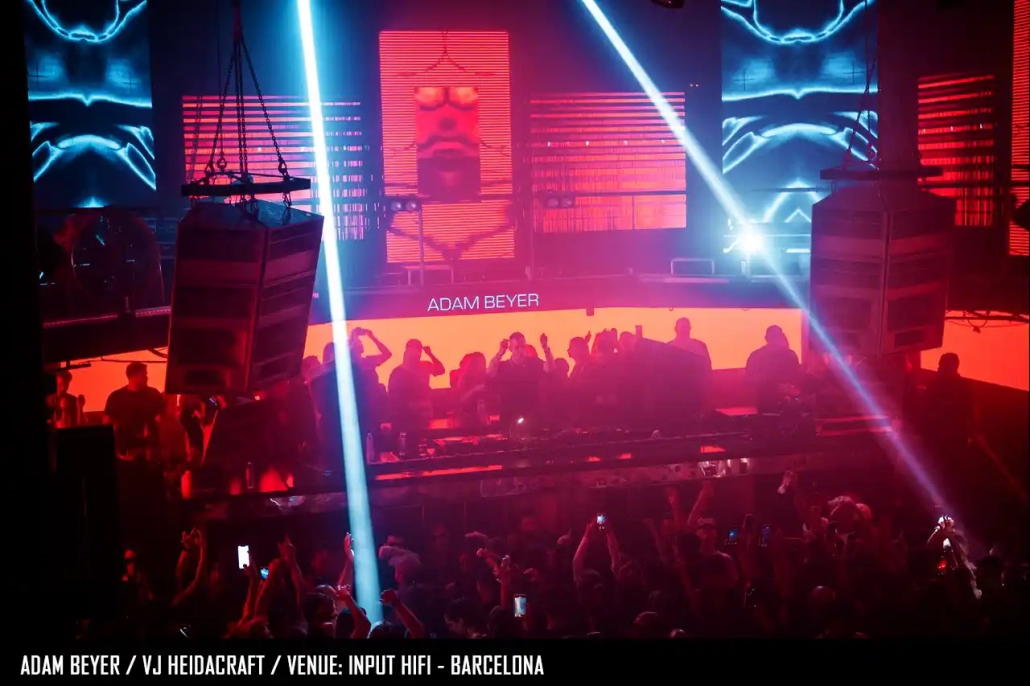
After more than a decade of constant evolution in the European scene, VJ HEIDACRAFT returns to her roots in La Paz. What began in 2003 as experimentation within the Bolivian underground movement transformed into a meteoric career, leading her to become the resident VJ at INPUT High Fidelity Sound System, one of the global epicenters of techno in Barcelona.
Today, with the experience of “piloting” visuals for legends like Adam Beyer, Deborah de Luca, and Ricardo Villalobos, she returns to Bolivia to lead an intensive workshop this March 23rd, aiming to professionalize the new generation of visual artists.
We sat down with her to discuss her journey, mental health within the industry, and the “ritual” behind the screens.
View this post on Instagram
Reconnecting with Bolivia
Neurotrance: You started in the La Paz underground scene in 2003 and today you return as an international reference. How do you perceive the evolution of visual culture in Bolivia since you migrated, and what motivates you to share your knowledge in this workshop?
HEIDACRAFT: I think when I left 10 years ago, the importance of the VJ figure within an electronic music ritual wasn’t yet fully perceived. It has clearly grown since then, but I believe there is still a long way to go.
What motivates me to share my knowledge is the feeling that Bolivia, in terms of talent, has nothing to envy the rest of the world. We have high-quality DJs and musicians, and I believe the visual aspect is essential for a complete, immersive experience. Before I leave again, I want to contribute my grain of sand for the new generations. I feel that sharing is caring; my biggest driver is gratitude toward everyone who helped me at the start of my path, and the love I have for our land and the communal ritual that is every event.
Discipline Behind the Chaos
N: Being a resident at a club like INPUT implies extremely high visual standards. How does a VJ’s mindset change when moving from sporadic gigs to “piloting” every week for the biggest names in world techno?
H: The pressure and demand are obviously very high. It’s vital to master the technical side while knowing how to control your nerves. Every time a figure like Deborah de Luca or Len Faki takes the helm musically, it helps me to remember they are people just like us. I remind myself to enjoy the session and recognize that this specific night will never be repeated.
Moving from hobby to profession has brought many personal changes, especially regarding my relationship with mental and physical health. To meet the demands of a job like this, I’ve had to make several structural adjustments in my life.
N: You’ve worked with styles ranging from industrial techno to minimalist sounds. How do you adapt your visual narrative in real-time for such different artists?
H: I have a personal methodology: first, I listen to and study the DJ, and from there, I create a concept. I’m like a chameleon; every session is a different world for which I change colors. Organizing my material and creating color palettes is essential. I like to name these worlds—things like “fractal journey,” “cosmic tour,” or “underground descent.” That’s where the creative work happens, beyond just the technical.
The Power of Technique: Beyond the Screen
N: You hold Master’s degrees in 3D Animation and Audiovisual Innovation. How has this academic rigor differentiated your “craft” style?
H: Understanding the 3D universe has helped me imagine my shows beyond the obvious. Thinking in 3D is like thinking in another language. Mastering the technique allows you to fly with more freedom in the creative universe. Furthermore, I have an obsession with moving beyond the screen, and I’ve been directing my artistic work toward that space in recent years.
N: The workshop covers advanced protocols like OSC, DMX, and Companion. Why does technical mastery grant an artist freedom during live improvisation?
H: As I’ve said before, when you master the technique, the creative process becomes more fluid. For me, the most frustrating thing has always been imagining something and not having the tools to materialize it. That’s why mastering the techniques is so important—it gives you freedom.
The La Paz Workshop: March 23rd – 27th
The workshop offers a comprehensive journey: from the history of visual art to advanced hardware configuration and LED outputs. According to HEIDACRAFT, having your software configured to your liking is 80% of the work, allowing for quick reactions to unexpected drops and ensuring the performance is fluid and fun for everyone involved.
N: What would you say to a digital artist or designer in La Paz who is hesitating to make the jump into professional Vjing?
H: I’d tell them not to hesitate and just take the leap. The visual world is infinite, and turning music into images is a beautiful task that provides unique mental richness.
WORKSHOP CONTENT:
DAY 1: VJ Art History & Basic Setup History of VJing, Resolume interface, composition, mixing, workspace optimization, formats/codecs (Resolume Alley), layers, groups, and BPM/SMPTE sync.
DAY 2: External Connections & Advanced Control Effects, parameter animation, Dashboard, transitions, and transport controls. Video sources, routers, and capture cards. Audio-reactive visuals. Software integration (Syphon, Spout, NDI). MIDI, OSC, DMX mapping, and Companion.
DAY 3: Projection & LED Screens Advanced Output configuration. Projector characteristics and projection techniques: Mapping, Blending, Warping. LED screens: basics, electronics, DMX, and Artnet. Live practice: Mapping and Blending setup.
DAY 4: Programming Resolume for Events Workflow adaptation for specific event needs. Real-time synchronization and control. Advanced video output and DMX integration for lighting/effects. Live streaming and recording.
DAY 5: Live Practice Preparation and execution of a live event. Final Project.
Workshop Information:
Date: Starting March 23rd.
Location: La Paz, Bolivia.
Content: Intro to Resolume, External Connections (MIDI/OSC/DMX), Mapping, LED Screens, and Live Practice.
Finally, HEIDACRAFT recommends this essential read: “God is a VJ – Who is a VJ?” by Alexander Kuiava. Read here.
